At De Monchy Natural Products, we are committed to delivering sustainably sourced raw materials that meet the evolving needs of our customers across the food, beverage, fragrance, and flavor industries. Building on our established expertise in vanilla, cassia, cinnamon, nutmeg, and turmeric, we are proud to expand our portfolio to include cloves, reinforcing our position as a trusted cloves supplier and single-source partner for natural spice ingredients.
Known for their intense warmth, rich aroma, and distinctive pungency, cloves are the dried flower buds of the clove tree (Syzygium aromaticum, also referred to as Eugenia caryophyllata), a species native to the Indonesian archipelago. Valued across centuries of global trade, cloves remain a critical raw material for food manufacturers, flavor compounders, fragrance houses, and pharmaceutical formulators. Their characteristic flavor profile has secured their role as a staple ingredient in industrial applications ranging from spice blends and seasoning systems to essential oil distillation and oral care formulations.
In this article, we dive into the origins of cloves, the different grading qualities and their use in various applications, providing the sourcing context and technical detail that ingredient buyers and procurement professionals need to make informed decisions.
Our Stock Availability – Bulk Madagascar Cloves
History and Origin of Cloves
Historically, cloves are native to Indonesia, specifically the Maluku Islands (the original center of origin), as well as the Sulawesi and Java regions. These equatorial zones offer the precise combination of tropical climate, consistent rainfall, and volcanic soils that clove trees require for optimal growth. Under these conditions, the trees produce dense clusters of small, crimson flower buds that are carefully harvested by hand before they bloom, a critical timing factor that directly influences the quality and volatile oil content of the final product.
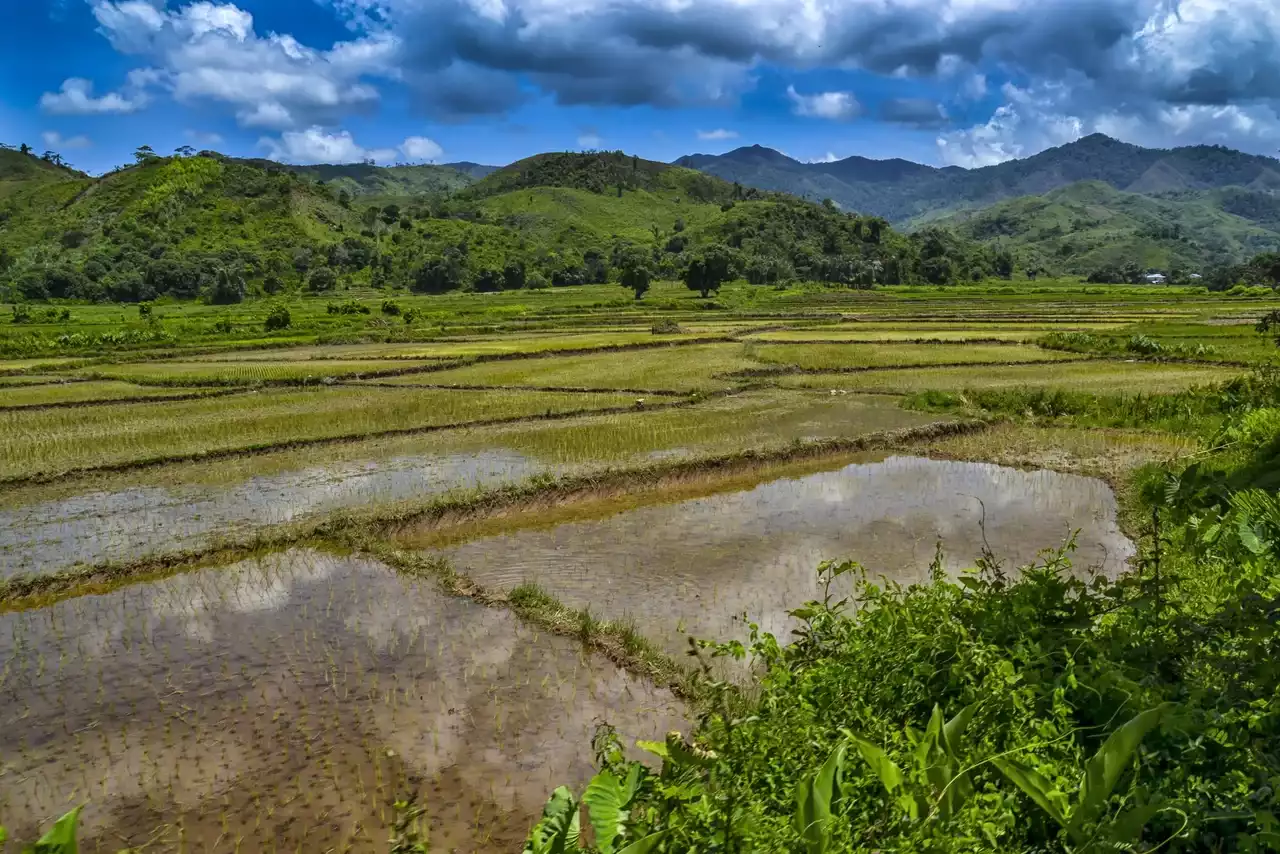
During the colonial era, cloves (like most high-value spices) were traded extensively and transplanted to new growing regions. As a result, clove cultivation now extends well beyond Indonesia, with significant production in Madagascar, Tanzania, Sri Lanka, and the Comoros Islands, where favorable equatorial conditions support consistent harvests. For procurement teams evaluating cloves sourcing options, understanding these regional origins is essential, as terroir, post-harvest processing methods, and local agricultural practices all influence the aromatic intensity, oil yield, and overall quality of the raw material.
As of 2022, Indonesia remains the principal producing country, accounting for more than 133,000 metric tons – approximately 73% of global production. Madagascar cloves production follows as the second-largest origin, contributing around 24,000 metric tons, while Tanzania produces roughly 8,600 metric tons (source: Tridge). It is notable, however, that essentially all cloves produced in Indonesia are absorbed by domestic consumption, where they serve as a primary ingredient in the widely popular local clove cigarettes known as “kretek.” This domestic demand significantly limits Indonesian export availability, making origins such as Madagascar and the Comoros Islands particularly important for international buyers seeking reliable bulk cloves supply. The specific characteristics of Madagascar cloves (including their aromatic profile and oil content) make them especially well suited for food and fragrance applications on the global market.
Identification and Classification of Cloves
Beyond evaluating quality, it is important for ingredient buyers to understand the varying forms of cloves available on the international market, as each format serves different industrial requirements.
The most common forms found in international trading are whole cloves and cloves headless raw material. Whole cloves are the intact floral buds harvested from the clove tree before blooming, then sun-dried or mechanically dried to reduce moisture content. Headless cloves consist only of the receptacle and sepals, the lower portion of the bud, having lost the dome-shaped “head” (the rounded upper part containing the petals). While headless cloves carry a lower grade designation, they still retain significant essential oil content and are widely used in ground spice production and extraction processes where visual appearance is not a primary concern.
Several other forms of clove spices exist in the supply chain. Mother cloves are the ovoid brown berries (the mature fruit of the clove tree) which carry a milder flavor and lower eugenol content than dried buds. Khoker cloves are whole cloves that have undergone partial fermentation due to incomplete or delayed drying, resulting in a softer texture and diminished aromatic potency. Clove stems consist of the woody stalk fragments separated from the buds, and while lower in volatile oil, they remain a cost-effective source material for essential oil distillation. Finally, ground cloves are the powder obtained by mechanically grinding dried cloves without any additives, a format commonly specified by food manufacturers for direct incorporation into spice blends, seasoning mixes, and baked goods formulations.
Grading qualities
In international trading, cloves are classified into three principal grades based on the guidelines established by ISO Standard 2254:2004: hand-picked superior grades (CG1), clean quality grades (CG2), and standard quality grades (CG3). These designations provide a standardized framework that allows buyers, traders, and cloves ingredients suppliers to communicate quality expectations clearly across the supply chain.
The grades are differentiated by several measurable parameters, including bud size and uniformity, harvesting maturity, moisture content, volatile oil concentration, and overall flavor and aroma intensity. For procurement professionals and product developers, understanding these grading tiers is critical to matching raw material specifications with end-use requirements. Higher-grade cloves (CG1) deliver the most concentrated flavor and aromatic impact, while CG2 and CG3 grades offer cost-effective alternatives for applications where visual uniformity or peak aromatic intensity are less critical.
Despite flavor and aroma variations across grades, CG2 and CG3 cloves retain meaningful essential oil levels and functional properties relevant to many industrial formulations.
Grade 1 – Hand-picked Cloves – CG1
Hand-picked cloves represent the highest quality tier available in the wholesale cloves market. Individually selected and sorted for size, shape, and color uniformity, CG1 buds are harvested at the peak of their maturity, when eugenol and other volatile compound concentrations are at their highest. This results in a bold, intensely aromatic profile that is favored in premium and gourmet applications, as well as by flavor houses requiring maximum aromatic impact from their natural cloves ingredients.
CG1 cloves typically exhibit moisture levels below 12% and a minimum volatile oil content of 17%, ensuring both shelf stability and strong organoleptic performance. Tolerances for defects are tight: headless cloves are limited to a maximum of 2%, khoker cloves to 0.5%, mother cloves to 0.5%, and other foreign matter is held to minimal levels. These strict specifications make CG1 the grade of choice for buyers prioritizing consistency, potency, and visual presentation in their supply of natural cloves for food manufacturers and fragrance compounders.
Grade 2 – CG2 Cloves
CG2 cloves buds are the most widely traded grade for retail food applications, culinary ingredient supply, and standard food manufacturing use. Slightly smaller and less uniform in shape than hand-picked CG1, CG2 buds still deliver a well-developed aroma — slightly milder than CG1 but entirely suitable for the majority of seasoning blends, spice mixes, and flavoring applications. Moisture content generally remains below 12%, and the buds are harvested at a favorable stage of maturity, which gives them a characteristically lighter color.
CG2 batches allow for moderately higher inclusion of secondary materials: up to 5% headless cloves, 3% khoker cloves, and 4% mother cloves. This grade represents an optimal balance between quality and cost efficiency for food manufacturers, making it the default specification for many industrial cloves supply contracts and bulk purchasing programs. For buyers evaluating Comoros cloves supply or other regional origins, CG2 provides a practical benchmark for comparing offerings from different cloves raw material suppliers.
Grade 3 – CG3 Standard Quality Cloves
CG3 cloves are classified as commercial-grade products and represent the most economical tier in the cloves wholesale market. Harvested when buds have reached full maturity, CG3 cloves exhibit a darker coloration and a less concentrated flavor profile compared to CG1 and CG2. Their size and shape are more variable, and tolerances for secondary materials are higher, with up to 6% mother cloves and 5% khoker cloves permitted in standard batches.
CG3 batches typically contain a minimum of 15% volatile oil — still a meaningful concentration for extraction and processing applications. This grade is the most suitable for large-scale industrial use, including essential oil distillation, pharmaceutical formulations, and mass-production food manufacturing where cloves function as a background flavor note rather than a featured ingredient.
For procurement managers sourcing high-volume industrial cloves supply, CG3 offers the most competitive price point while still meeting functional quality thresholds.
Conclusion
Sourced primarily from Madagascar and the Comoros Islands, two origins recognized for their consistent quality and favorable growing conditions, cloves represent a strategic addition to De Monchy Natural Products’ expanding spice portfolio. Available in both conventional and organic certifications, our cloves supply supports the sustainability commitments and responsible sourcing goals that are increasingly central to our customers’ procurement strategies.
Together with our established range of vanilla, cassia, cinnamon, nutmeg, and turmeric, this addition reinforces our role as a comprehensive cloves raw material supplier and one-stop sourcing partner for the food, flavor, and fragrance industries.